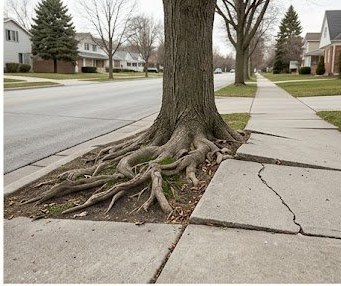
If the tree is in a city-maintained planting strip (the space between the sidewalk and street), you may not owe anything — or at least not the full cost. In cities like Los Angeles, the city is now legally obligated to cover tree-caused damage. In others, you still pay even for city trees. The key is documenting that a city tree caused the damage before any repair work happens.
The Three Scenarios — And What Each Means for You
Tree root sidewalk damage falls into three distinct scenarios based on tree ownership, and each carries a different legal and financial outcome. Before you touch a shovel or call a contractor, you need to know which scenario applies to your property.
Scenario 1: The Tree Is in the City's Planting Strip
The planting strip — also called the parkway, tree lawn, or boulevard — is the strip of land between the edge of the sidewalk and the curb. Trees planted in this zone are typically owned and maintained by the city. In most cities, city-owned trees grow without much oversight until their roots begin heaving adjacent concrete — at which point the city's legal exposure varies dramatically by jurisdiction.
In Los Angeles, a landmark 2016 Americans with Disabilities Act consent decree committed the city to repairing sidewalk damage caused by city-maintained trees at no cost to adjacent homeowners. The city's Bureau of Street Services handles these complaints through a dedicated tree damage report system. This is one of the most homeowner-favorable rules in the country — but you have to know to ask and document the tree's role before repairs happen.
In New York City, the Parks Department maintains over 700,000 street trees. If a city tree damages your sidewalk, you can file a complaint through NYC 311, and the Parks Department is supposed to repair or remove the root issue. In practice, response times vary significantly by borough, and some homeowners end up making repairs themselves after waiting months. The city's responsibility is real but not always fast.
In Seattle, city trees are managed by the Urban Forestry division. Sidewalk damage caused by a city tree is supposed to be reported to SDOT, which then evaluates whether to repair or contribute to the cost. Seattle's cost-sharing program for sidewalk repairs covers some tree-root cases, though eligibility depends on the specific tree designation and location.
In Chicago, where the city generally maintains sidewalks citywide anyway, tree-root damage is simply part of the city's maintenance obligation. Homeowners report the damage through 311 and the city schedules the work.
In Houston, Dallas, and most Texas cities, the rules are less favorable: even city-tree damage often remains the homeowner's financial obligation under the adjacent-property-owner model. The city may remove the offending tree root if it constitutes a hazard, but the sidewalk repair bill typically lands with the homeowner regardless.
Scenario 2: The Tree Is on Your Private Property
If the offending tree is on your private property — including in your front yard within your property line, not in the public right-of-way — there is almost no jurisdiction in the U.S. where the city will share the repair cost. You own the tree, you own the problem. This is true even if the roots traveled beyond your property line to reach the sidewalk, which they commonly do.
The repair obligation here is clear and consistent: you are responsible for both the sidewalk repair and for managing the tree going forward. Depending on the city's rules, you may also be required to remove or root-prune the tree as part of the permit process to prevent recurrence. Some cities will cite you for failure to prevent recurrence if the same tree causes additional damage within a specified period.
If your tree has caused damage to a neighbor's property beyond the sidewalk, you may also face a civil liability claim depending on your state's negligence laws for tree hazards — a separate issue entirely from the sidewalk repair obligation.
Scenario 3: The Tree Is on a Neighbor's Property
Neighbor's-tree situations are genuinely complicated and vary significantly by state. In general, you are responsible for repairing your sidewalk regardless of where the offending roots originated — the city holds the adjacent property owner responsible for the sidewalk condition, full stop. Your recourse against a neighbor for contributing to the damage is a private civil matter, not something the city adjudicates.
Some homeowners successfully recover costs from neighbors whose private trees caused documented sidewalk damage, but this typically requires a demand letter and potentially small claims court. The evidentiary bar — proving causation, documenting the tree's encroachment, showing the neighbor was aware of the risk — is higher than most homeowners expect.
How to Document That a City Tree Caused Your Damage
Documentation is everything in a tree-root dispute. If you can prove the damage was caused by a city-maintained tree, you may recover the full repair cost or avoid it entirely — but only if you document before repairs begin. Once the damaged concrete is removed, the evidence is gone.
Take detailed photographs showing the root system emanating from the city tree toward the damaged slab. Measure and photograph the distance from the tree trunk to the affected panel. Note the tree identification tag or number if present (many cities tag street trees). Check the city's street tree database — most major cities have online maps of their street tree inventory — and confirm the tree is indeed city-owned at your address. Take a screenshot and print or save it. Request a copy of the city's tree maintenance records for that address through a public records request if needed.
With this documentation, file a formal complaint or damage report with your city's urban forestry or public works department before contacting a contractor. In cities with tree-damage programs, this filing initiates the process. In cities without formal programs, it creates a paper trail that may support a cost dispute or reimbursement request later.
City-By-City Tree Damage Rules: Quick Reference
| City | City Tree Damage Rule | Program? | Source |
|---|---|---|---|
| Los Angeles | City pays (ADA consent decree) | Yes — file with BSS | LA Bureau of Street Services |
| New York City | City responsible — file via 311 | NYC Parks review | NYC Parks / 311 |
| Chicago | City handles most repairs | City-maintained system | Chicago Dept. Transportation |
| Seattle | Cost-share possible | SDOT cost-share program | Seattle SDOT |
| Portland | Partial programs | Urban Forestry review | Portland Urban Forestry |
| Houston | Owner pays — limited city relief | None standard | Houston Public Works |
| Dallas | Owner pays | None standard | Dallas Public Works |
| Philadelphia | Varies by tree program | L&I review required | Philadelphia L&I |
| Denver | Cost-share available | Denver Sidewalk Program | Denver Public Works |
| Sacramento | Tree damage program | Yes — Sacramento specific | Sacramento Public Works |
Root Pruning: The Option Nobody Talks About
In some cases, the city or a licensed arborist can prune the offending roots to a depth that prevents further heaving without removing the tree. Root pruning is typically less expensive than full panel replacement and can be paired with a concrete repair to permanently resolve the issue. Some cities require root pruning as part of the sidewalk repair permit in tree-adjacent locations.
Root pruning is not always appropriate — aggressive root cutting close to a large tree can destabilize it and create a liability hazard. The decision should involve a licensed arborist, not just a concrete contractor. If the city tree is the cause and the city declines to repair the sidewalk, requesting that they at least authorize and perform root pruning — at city expense — is a reasonable ask that sometimes gets traction.
The ADA Factor
When you repair a heaved sidewalk panel, ADA (Americans with Disabilities Act) accessibility standards come into play. Replaced panels must meet current cross-slope requirements (no more than 2% perpendicular to travel), running slope limits, and transition requirements at curb cuts. In many cities, this means that repairing a tree-heaved panel also requires upgrading a nearby curb cut to current ADA standards — a cost that can equal or exceed the panel replacement itself. Our ADA sidewalk requirements guide covers when upgrades are triggered and how costs are typically allocated.
Suspect a city tree? Document before calling anyone.
Photograph the roots, save the city tree map screenshot for your address, and file a formal complaint with your urban forestry or public works department before a contractor removes any concrete. Once the damaged slab is gone, your evidence goes with it.
Frequently Asked Questions
In most cities, yes — it's legal and common. Cities that use the property-owner-responsible model typically assign repair obligations to adjacent owners regardless of cause. LA, NYC, and Chicago are the major exceptions. If your city offers no relief for city-tree damage, your options are limited to the formal complaint process, an appeal hearing, or small claims court — all of which have mixed success rates.
In some cities, yes. Certain jurisdictions require that when a tree on private property causes sidewalk damage, the homeowner must root-prune or remove the tree as a condition of the repair permit. This is city-specific — check your permit requirements and ask the public works department directly before assuming the tree can stay.
Most major cities maintain online street tree inventories or GIS maps. Search "[your city] street tree map" or "[your city] urban forest inventory." You can also call your city's parks or public works department and provide your address — they can confirm whether any trees in the public right-of-way at your address are in the city's inventory.
You are still responsible for the sidewalk repair regardless of the tree's origin. Your recourse against the neighbor is civil, not through the city. Document everything, research your state's tree encroachment liability standards, and if the costs are significant, consult an attorney about a demand letter or small claims action. Many neighbor disputes are resolved informally when the neighbor understands their exposure.
Potentially, in cities with tree-damage programs. Document the city's planting in writing — get a record of the planting date and tree species if possible. In cities like LA with a consent decree, new plantings that damage the adjacent sidewalk within a reasonable period would likely fall within the city's repair obligation. In cities without programs, future damage from a city-planted tree would need to be pursued through the same process: file, document, and escalate.
Disclaimer: Informational only. Not legal advice. Verify current rules with your city's public works or urban forestry department before acting.