Under the ADA, any alteration to a sidewalk — including repair or replacement — triggers a legal requirement to make the altered portion and its "path of travel" compliant with current accessibility standards. This can require upgrading curb cuts, adjusting cross-slopes, and adding detectable warning surfaces even when your repair notice only cited a cracked panel.
What the ADA Actually Requires for Sidewalk Repairs
The Americans with Disabilities Act requires that when a public entity alters a facility (which includes repairing a sidewalk in a public right-of-way), the alteration must be made accessible to the maximum extent feasible. The Department of Justice's implementing regulations and the DOT's Public Rights-of-Way Accessibility Guidelines (PROWAG) establish the specific technical standards.
For sidewalks, the key standards are: running slope no greater than 1:20 (5%) — or 1:16 where the terrain requires it with cross-slope compensation; cross-slope no greater than 1:50 (2%); minimum clear width of 60 inches where possible, but not less than 36 inches; stable, firm, and slip-resistant surface; and smooth transitions at joints with no vertical change greater than 0.5 inch (beveled) or 0.25 inch (unbeveled).
When you replace a sidewalk panel adjacent to a curb or intersection, the "path of travel" obligation kicks in: the nearest curb ramp must also be brought into compliance if it isn't already. This is the upgrade that surprises most homeowners — you expected to pay for one panel, and now you're also being asked to fund a curb ramp upgrade. In some cases, this doubles the project cost.
Who Bears the ADA Upgrade Cost?
In theory, the ADA places the upgrade obligation on the entity performing the alteration. When a homeowner performs a repair in the public right-of-way under a city permit, the responsibility allocation becomes a practical question of how your city interprets and enforces the requirement. In cities with active ADA enforcement programs — Los Angeles, San Francisco, Seattle — permit inspectors will flag non-compliant curb cuts adjacent to your repair area and may require upgrades as a condition of permit close-out. In cities with less aggressive enforcement, the requirement may technically exist but not be enforced at the permit level.
Some cities have used their ADA consent decrees (like LA's) to fund curb cut upgrades citywide, eliminating the homeowner's obligation to fund curb work adjacent to their sidewalk repair. In these cities, the homeowner pays for the panel repair and the city funds the curb work — a practical split that works in the homeowner's favor. Always ask your city's public works department specifically whether curb cut upgrades adjacent to your repair area will be required and who is responsible for funding them. Get the answer in writing.
Detectable Warning Surfaces
Detectable warning surfaces (DWS) — the truncated dome surfaces you see at crosswalk intersections — are required at curb ramps under federal standards. If your repair triggers a curb ramp upgrade, the upgraded ramp must include compliant DWS. These surfaces cost $150–$400 per installation depending on material and size. Many cities have approved specific DWS products and require homeowners or their contractors to use only city-approved materials — confirm approved products with your public works department before purchasing.
Practical Steps for ADA Compliance
When your contractor comes to assess the scope, ask them specifically about ADA compliance requirements for your location. Experienced sidewalk contractors in urban markets know which permit offices are actively enforcing ADA requirements and can advise on what upgrades are likely to be required during the inspection phase. Before work begins, confirm with the city whether the adjacent curb ramp is already compliant — if yes, document that with photos, and the path-of-travel obligation for the curb may be satisfied. Our contractor selection guide includes specific questions about ADA compliance experience to ask during the bid process.
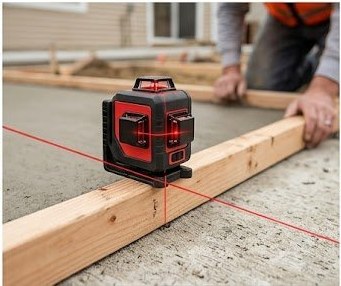
Motovera Self-Leveling Cross-Line Laser Level — #1 Best Seller
ADA compliance requires sidewalk cross-slope no greater than 2%. This 100-ft self-leveling green cross-line laser with tripod lets you verify your contractor's work — and catch a non-compliant pour before the inspector shows up. Includes manual and self-leveling modes, IP54 waterproof rating, and 4 brightness settings. Exactly what you need on pour day.
View on Amazon →As an Amazon Associate, we earn from qualifying purchases at no extra cost to you.
Frequently Asked Questions
Technically, the ADA applies to public entities (government agencies) and requires that alterations to public rights-of-way be accessible. When a homeowner performs a permitted repair in the public right-of-way, the city's permit conditions often incorporate ADA requirements — making compliance a condition of your permit, not a direct ADA obligation on you individually. The practical effect is the same: non-compliant work fails inspection.
Not necessarily — only if your repair project triggers the path-of-travel obligation. If you're replacing a panel that is not in the immediate path of travel to a non-compliant curb ramp, the upgrade obligation may not attach. Discuss the specific location with your city's permit office before beginning work.
Inconsistent enforcement doesn't eliminate the legal requirement. If your inspector flags the non-compliance, you'll need to remedy it regardless of what happened on neighboring properties. Going in compliant protects your permit close-out and eliminates the enforcement uncertainty.
When ADA Upgrades Do and Don't Apply: The Path-of-Travel Rule in Practice
The "path of travel" concept is the linchpin of ADA compliance in sidewalk repair, and most homeowners misunderstand it. A path of travel is not simply the nearest curb ramp — it's the entire accessible route connecting the repaired element to the street and any adjacent facilities. When you alter a portion of an accessible route, you must make the path of travel to the altered area compliant as well, to the maximum extent feasible.
In practical terms, this means: if you replace a sidewalk panel adjacent to a non-compliant curb ramp, the path of travel to the nearest usable curb crossing now runs through your repaired panel and the non-compliant curb ramp is part of that path. The DOT's PROWAG standards require that when a property owner or entity undertakes an alteration, they must ensure the entire accessible path to that alteration point meets current standards — which typically includes the curb ramp, any cross-slope issues in adjacent panels, and any width constrictions.
The good news for homeowners is that cities interpret "maximum extent feasible" with some practical flexibility. Many permit inspectors will accept a properly sloped replacement panel adjacent to an existing (if outdated) curb ramp without requiring a full curb reconstruction, particularly in residential contexts where the ramp meets older standards that were compliant when installed. The key is documentation: before your repair begins, photograph and measure the existing curb ramp and adjacent panels. If they meet the older (pre-2011) PROWAG standards, note this with your permit inspector. If they don't, get a written determination from the city about what upgrade scope they require as a condition of permit close-out before any concrete is poured.
In cities with active consent decrees — particularly Los Angeles, where the 2016 ADA settlement committed the city to a 30-year sidewalk remediation program — the city has defined specific responsibility for ADA upgrade costs adjacent to city-maintained trees. If a homeowner is repairing tree-caused damage under the Bureau of Street Services program, the associated curb work may fall within the city's funded scope rather than the homeowner's. Always ask the program coordinator specifically about ADA upgrade responsibility when applying to a city program — the answer can be worth thousands of dollars.
Detectable Warning Surface Requirements: The Details That Matter
Detectable warning surfaces (DWS) — the truncated dome fields installed at curb ramps and hazardous pedestrian crossings — are one of the most technically specific elements of ADA compliance and one of the most common sources of inspection failure in sidewalk repair projects. Understanding the requirements before your repair begins prevents costly post-pour remediation.
Federal standards require DWS at curb ramps, raised crosswalks, and other locations where the pedestrian path meets a vehicular way without a level change. The domes must be: 0.2 inches in height (nominal); 0.9 inches center-to-center in each direction; contrast visually with the surrounding surface (either by color or texture contrast); and extend the full width of the curb ramp, not less than 24 inches in depth in the direction of pedestrian travel. In most major cities, yellow is the required color — though some cities have adopted red or brick-toned DWS in historic districts. Always confirm the required color with your permit office before purchasing materials.
Common DWS materials include cast-iron dome tiles (durable but expensive, around $25–$40 per square foot), polymer composite panels (lighter, around $18–$30 per square foot), and surface-applied epoxy systems (lower cost around $8–$15 per square foot, shorter lifespan). In cities with harsh winters, surface-applied systems can delaminate due to freeze-thaw cycles — cast-iron or composite panels are more appropriate in northern climates. Your city may have an approved products list for DWS — using an unapproved material is a common inspection failure point even when the installation dimensions are correct.
Disclaimer: Informational only. Not legal advice. Verify current rules with your local public works department.