In virtually every U.S. city, repairing a sidewalk in the public right-of-way — even a small section — requires a permit issued before work begins. No permit means the work can be rejected at inspection and ordered removed. The permit process typically takes 2–7 business days and costs $50–$250.
Why Permits Are Required — and Why You Shouldn't Skip Them
Sidewalk permits exist because the sidewalk is public infrastructure. Even though the repair obligation often falls on the adjacent property owner, the city retains control over what gets built in its right-of-way. A permit is the city's mechanism for ensuring that private repairs meet public safety standards — specifically, ADA accessibility requirements, material specifications, thickness requirements, slope tolerances, and joint placement rules that ensure the repaired section integrates safely with the surrounding infrastructure.
Skipping the permit is one of the most expensive mistakes in sidewalk repair. When a city inspector discovers unpermitted work — which happens during routine inspections, complaint investigations, and final permit close-outs — they can order the work demolished and redone. You've paid for the original repair, you pay for the demolition, and you pay for the second repair. In cities with active enforcement (Los Angeles, New York, San Francisco), unpermitted sidewalk work that is reported by a neighbor or discovered during an adjacent job can trigger exactly this sequence. The permit fee is among the best insurance premiums you'll spend.
Where to Apply for a Sidewalk Repair Permit
Permit authority varies by city. In most cities, sidewalk repair permits are issued by the Department of Public Works or the Department of Transportation — not the Building Department, which handles structural improvements to the building itself. In some cities with consolidated permit centers, you apply through a single portal that routes the application to the appropriate department. In others, you must go directly to public works.
Your sidewalk repair notice should identify the permitting department. If it doesn't, search "[your city] sidewalk repair permit" and look for official city sources. Most major cities now have online permit portals. In Los Angeles, sidewalk work permits are issued through the Bureau of Engineering. In New York City, through the NYC DOT Highway Inspection and Quality Assurance (HIQA) system. In Chicago, through the Chicago Department of Transportation's permit center. In smaller cities, you may need to visit City Hall in person.
What the Permit Application Requires
A standard sidewalk repair permit application typically requires: the property address and Assessor Parcel Number (APN); the notice case number if you've received an official notice; a description of the proposed work scope (linear feet, square footage, panel count, repair method); the name and license number of the contractor who will perform the work (or a homeowner statement if self-performing); acknowledgment that the work will meet city specifications; and the permit fee payment. Some cities require a site sketch showing the location of the proposed work relative to property lines, curb, and adjacent panels.
Many cities require that the permit application be submitted by the licensed contractor, not the homeowner. If this is the case in your city, make sure your selected contractor pulls the permit before starting work — don't assume this is happening automatically. Confirm the permit number and application status before work day.
Material Specifications: What Inspectors Look For
The most common reason sidewalk repair work fails inspection is non-compliant material specifications. Inspectors check: concrete mix design (typically 3,500–4,000 psi minimum compressive strength at 28 days); slab thickness (typically 4 inches minimum for residential, 6 inches where vehicle crossings are possible); cross-slope (2% maximum perpendicular to travel direction); running slope (matching the surrounding grade, typically within 1:20); joint type and depth (control joints at 5-foot intervals, expansion joints at corners and adjacent to structures); and surface finish (broom finish, not smooth, for slip resistance).
ADA compliance is increasingly scrutinized in all major cities — particularly the cross-slope requirement, which requires a level (within 2%) surface that allows wheelchair users to travel without drifting. Getting this right requires a good contractor who uses a digital level during finishing, not just a visual estimate. A panel that looks level can fail at 2.5% slope and require grinding or replacement.
The Inspection Process
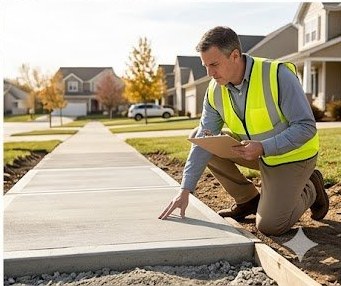
Most cities require two inspections for sidewalk repair: a pre-pour inspection (after forming but before concrete is placed) and a final inspection (after the concrete cures and the forms are removed). Some cities accept a single final inspection if the contractor submits pre-pour photos. Never close forms and pour without confirming whether a pre-pour inspection is required in your city — if it is and you miss it, you may be required to remove the fresh concrete to allow the inspection.
Schedule inspections as soon as the work reaches the inspection-ready stage. Most cities have next-business-day or within-48-hour inspection scheduling for routine permits. Don't schedule the inspection for the same day as the pour — concrete must cure a minimum of 48–72 hours before most cities will pass a final inspection. Our deadline calculator accounts for inspection scheduling time in its timeline estimates.
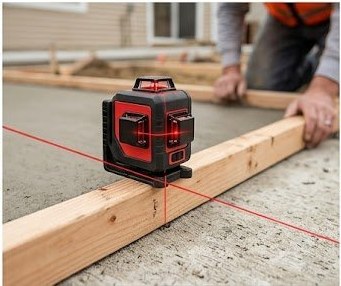
Motovera Self-Leveling Cross-Line Laser Level — #1 Best Seller
ADA compliance requires sidewalk cross-slope no greater than 2%. This 100-ft self-leveling green cross-line laser with tripod lets you verify your contractor's work — and catch a non-compliant pour before the inspector shows up. Includes manual and self-leveling modes, IP54 waterproof rating, and 4 brightness settings. Exactly what you need on pour day.
View on Amazon →As an Amazon Associate, we earn from qualifying purchases at no extra cost to you.
Frequently Asked Questions
Most sidewalk repair permits are valid for 6–12 months from the issue date. If your permit expires before the work is complete (due to weather delays, contractor scheduling, etc.), you'll need to renew it — typically a simple fee-based extension. Don't let the permit expire before the final inspection is completed and passed.
In most cities, yes — homeowners can pull their own permits for repairs to sidewalks adjacent to their residences. You'll need to certify that you understand the specifications and will perform the work yourself. The inspection requirements are the same as for contractor work. Some cities restrict self-performed work to certain repair types or square footage limits.
Sometimes — grinding (mechanical removal of a vertical lip without removing or replacing concrete) is treated differently than replacement in some cities. Check with your specific public works department. Even where grinding doesn't require a permit, you should get written confirmation of that fact from the city before proceeding without one.
Disclaimer: Informational only. Not legal advice. Verify current rules with your local public works department.